
Rejestracja zagranicznych aktów stanu cywilnego w Polsce (np. zagranicznych aktów urodzenia i małżeństwa)

Registration of foreign civil status records is a key legal step for individuals who need their foreign birth or marriage certificates recognized in Poland.
‘Every person in the modern world is a member of two basic communities: the family and the whole society organized into a state. From this belonging derive certain human characteristics, which determine his position in each of these communities and allow him to distinguish from other people’ (J. Ignatowicz).

Pojęcie stanu cywilnego

According to Polish law, every person is ascribed the following: sex, age, name, family affiliation, or surname – these are so-called strictly personal characteristics.
These characteristics together form a person’s civil status and define their legal identity.

In the current legal state, the issues of civil status registration are regulated primarily in the Law of 28 November 2014 – Law on Civil Status Records.
This act sets out the rules for registering, updating, and transcribing civil status events in Poland.

Let’s start with an explanation of the concept of civil status.
The above-mentioned law defines civil status as the legal situation of a person expressed by the characteristics that individualize a person, shaped by natural events (birth, death), legal actions (acknowledgment of paternity, marriage), or court decisions (adoption, recognition as dead, dissolution of marriage), or a decision of authorities (for example, decisions to change the name or surname), stated in a civil status record.
In practice, civil status records are the official legal proof of these events.

Rejestr religijny a świecki

In Poland, as in other countries, a system of religious registration was maintained for many years.
For a long time, churches and religious institutions were responsible for recording births, marriages, and deaths.

In the interwar period, only the former Prussian partition had a secular register.
A significant disadvantage of the registration system inherited from the invaders was the fact that it was not universal. Failure to register such a fact as birth meant that such persons did not exist in the eyes of the law.
This created serious legal and administrative consequences for individuals.

Initial work on the preparation of a composite law on civil status records was undertaken as early as 1919, but it was not until after the Second World War that a secular registration of civil status records was established.
The first Polish law to address this issue was the Decree of 25 September 1945, Law on Civil Status Records.
This marked the beginning of a uniform, state-managed civil registration system in Poland.

Rejestracja aktów stanu cywilnego w Polsce

The registration of civil status is a task of public administration. Actions in this field are carried out by the head of the civil registry office or his deputy.  In Poland, this authority is the Civil Registry Office (Urząd Stanu Cywilnego).

Outside Poland, some of the actions in this field are carried out by a consul or a person designated to carry out his functions. This allows Polish citizens and applicants abroad to complete formalities without travelling to Poland.

Akty stanu cywilnego rejestruje się w rejestrze stanu cywilnego w formie aktów stanu cywilnego. Rejestr ten prowadzony jest w systemie teleinformatycznym. Today, civil status data in Poland is maintained digitally, ensuring nationwide access and consistency.

Transcription of foreign civil status records

The aforementioned law provides for the possibility of registering an event that took place outside the Republic of Poland and regulates the institution of transcription of the civil status record.

The transcription of a civil-status record, also known as its location, is a form of transferring a foreign civil-status document to the Polish civil-status register.
This applies, for example, to foreign birth certificates, marriage certificates, or divorce records.

It consists of a faithful and literal transfer of the content of this document, both linguistically and formally, without any interference in the spelling of the names and surnames of the persons indicated in this document.
No changes or corrections are made to the original data during transcription.

The transcription is also performed by the head of the Civil Registry Office (Urząd Stanu Cywilnego).
Once completed, the foreign event is officially recognized under Polish law.

It should be emphasized that while the process of confirmation of Polish citizenship for our clients is underway, we simultaneously transcribe their civil status documents (births, marriages, and divorces).
This parallel approach significantly shortens the overall timeline of the procedure.

When the Polish citizenship confirmation proceeding ends with a positive decision, to apply for a Polish passport it is required to also provide all necessary civil status records already registered by the Polish Civil Registry Office.
Without transcription, applying for a Polish passport is not possible.

Samples of Polish civil status records

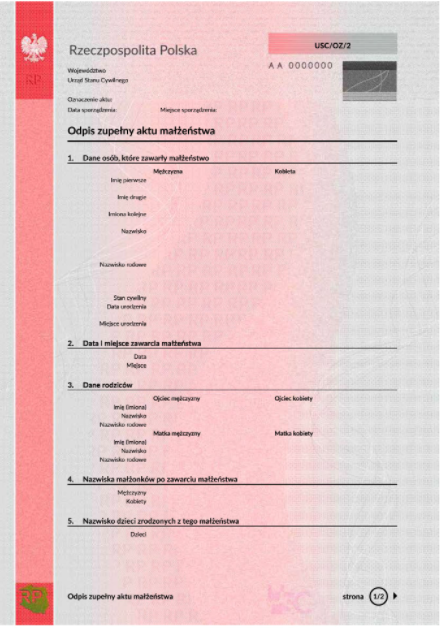
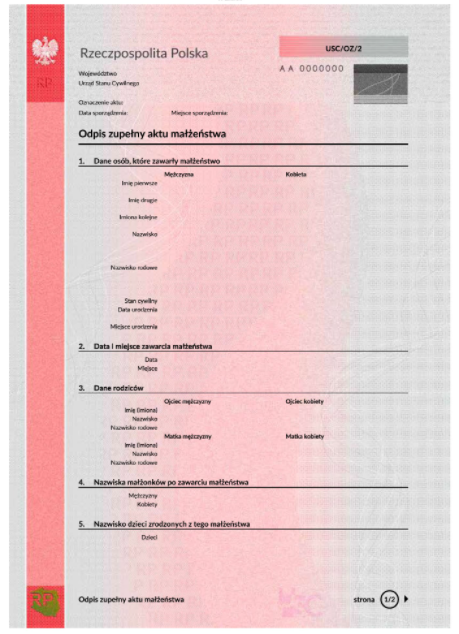
Poniżej znajduje się kilka przykładów najnowszych wersji polskich aktów urodzenia i polskich aktów małżeństwa:


Wzór nowego polskiego aktu urodzenia
pl bc

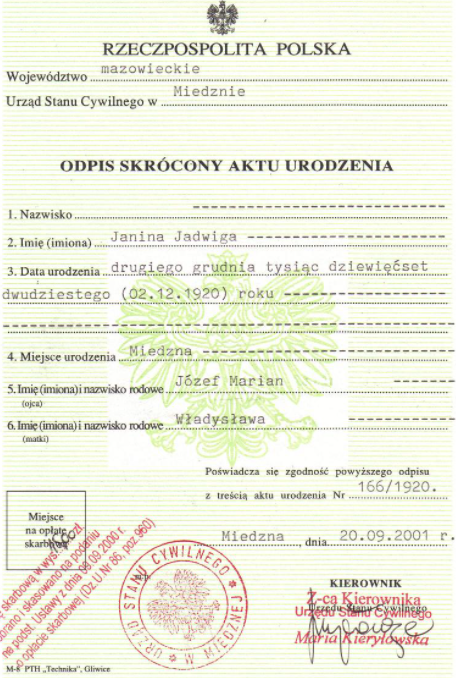
Przykład starszej wersji polskiego aktu urodzenia
pl bc old version

Please keep in mind the above version of the Polish birth certificate is still valid and in use. Older Polish birth certificates remain legally valid. If you have your original Polish birth certificate looking like the above document, you can easily use it while applying for a Polish passport and there is no need to obtain a new duplicate as long as your Polish birth certificate is in good and readable condition.  

Wzór nowego polskiego aktu małżeństwa
PL MC


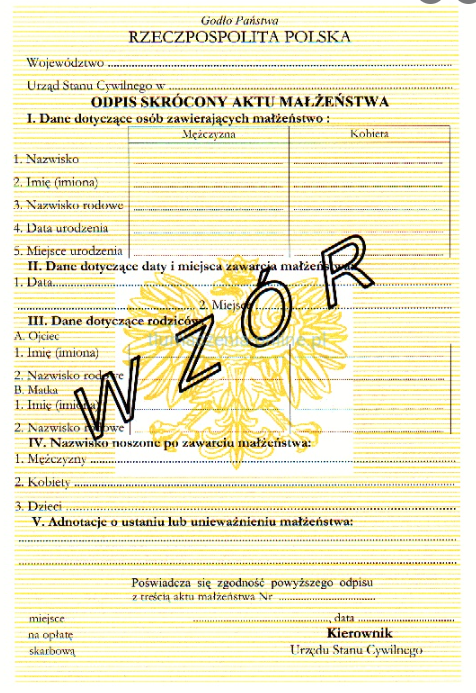
Przykład starszej wersji polskiego aktu małżeństwa
pl mc old

Należy pamiętać, że powyższa wersja polskiego aktu małżeństwa jest nadal ważna i używana. Jeśli posiadasz oryginalny polski akt małżeństwa wyglądający jak powyższy dokument, możesz z łatwością użyć go podczas ubiegania się o polski paszport i nie ma potrzeby uzyskiwania nowego duplikatu, o ile polski akt małżeństwa jest w dobrym i czytelnym stanie.  

FAQ – Registration of foreign civil status records in Poland

Is transcription of a foreign birth or marriage certificate mandatory in Poland?

Yes. Transcription is required if you need your foreign civil status record to be legally recognized in Poland, for example when applying for Polish citizenship or a Polish passport.


Can I apply for a Polish passport without transcribing my foreign civil status documents?
No. Polish authorities require all relevant civil status records (such as birth or marriage certificates) to be registered in the Polish Civil Registry before a passport can be issued.


Does transcription change the content of my foreign certificate?
No. Transcription is a faithful and literal transfer of the foreign document into the Polish civil status register, without altering names, surnames, or other personal data.


Where can transcription of foreign civil status records be completed?
Transcription can be carried out by a Civil Registry Office (Urząd Stanu Cywilnego) in Poland or, in certain cases, through a Polish consul abroad.

Stawanie się obywatelem polskim na mocy prawa krwi

Obywatelstwo polskie jest przekazywane "prawem krwi". Jeśli jedno z rodziców posiada polskie obywatelstwo (lub jest osobą polskiego pochodzenia), przechodzi ono na dziecko niezależnie od tego, czy urodziło się ono w Polsce, czy za granicą.
Dotyczy to również osób urodzonych w krajach posiadających "prawo ziemi", np. w USA. Jeśli urodziłeś się w USA z co najmniej jednym polskim rodzicem (lub rodzicem polskiego pochodzenia - z polskimi dziadkami), możesz ubiegać się o polskie obywatelstwo pomimo faktu, że nabyłeś obywatelstwo amerykańskie po urodzeniu.

Korzyści płynące z posiadania polskiego obywatelstwa

Po otrzymaniu polskiego obywatelstwa stajesz się nie tylko obywatelem polskim, ale także obywatelem europejskim. Dlaczego o tym wspominamy? Możliwość nazywania się obywatelem europejskim i łatwy dostęp do UE to główne korzyści płynące z polskiego obywatelstwa.

Narodowość polska a obywatelstwo polskie - jaka jest różnica?

Pojęcie obywatelstwa polskiego nie posiada definicji ustawowej. W doktrynie definiowane jest jako pewnego rodzaju więź prawna łącząca osobę fizyczną z państwem, polegająca na przynależności tej osoby do tego państwa. Wyraża się ona w zapewnieniu obywatelom przez państwo praw i nałożeniu na nich obowiązków, które istnieją po to, aby wskazać sposoby nabycia i zachowania obywatelstwa oraz związane z tym uprawnienia lub ich brak.